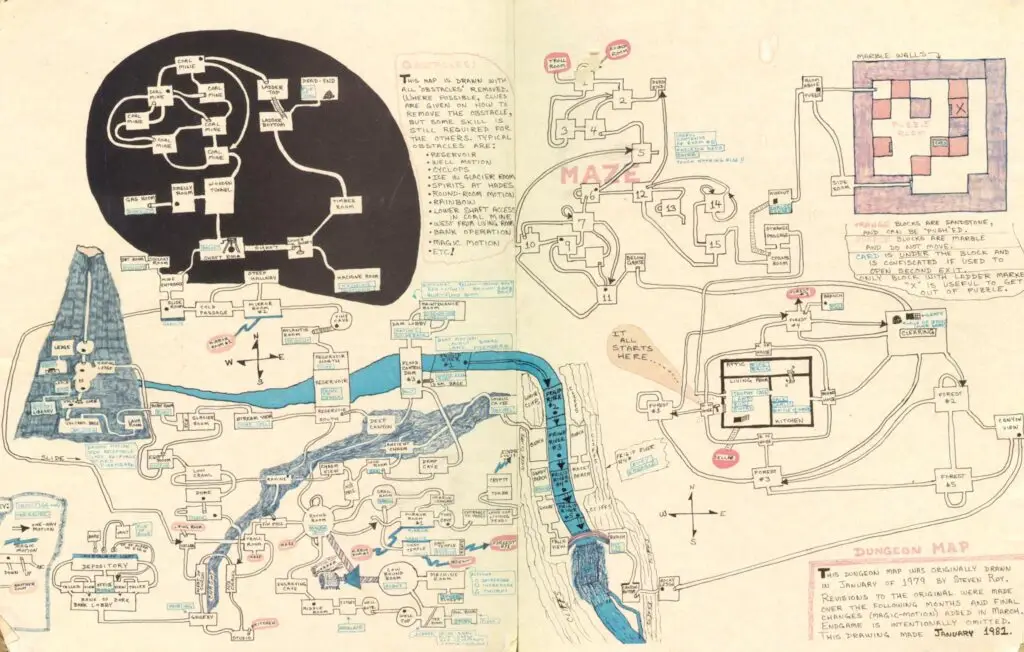
You are standing in a Distributed Cluster…
In November 2025, Microsoft (through the Open Source Programs Office, Team Xbox, and Activision) open-sourced the original source code for Zork I, II, and III with a simple goal: put historically important code back into the hands of students, teachers, and developers so they can study it, learn from it, and, perhaps most importantly, play it.
That announcement got me thinking…
If Zork is one of the great interactive adventures of early computing, then YugabyteDB is one of the great interactive adventures of modern distributed systems … and it’s open source too!
So here’s a fun YugabyteDB Tip inspired by the classic game I played for hours as a kid… and the database I still happily spend hours exploring today!
🏰 Zork: The Original Open-Source Dungeon
Zork didn’t rely on graphics… it relied on imagination, puzzles, and a custom VM called the Z-Machine. Back in the day it let the same story files run anywhere: TRS-80, PDP-10, Commodore 64, even weird 80s terminals.
Now that it’s open source, you can read the original engine, study the compiler, and wander down twisty passages with pure nostalgia.
🎯 Preservation, education, exploration.
🗄️ YugabyteDB: The Distributed Dungeon
YugabyteDB is open source under Apache 2.0 and lives at:
Instead of underground dungeons, we explore:
● Distributed consensus groups
● Sharded tablets
● Multi-region replication
● Query plans that may or may not be plotting against you
● Hot shards that leap out from the darkness like Grues
🎯 Performance, resilience, scalability.
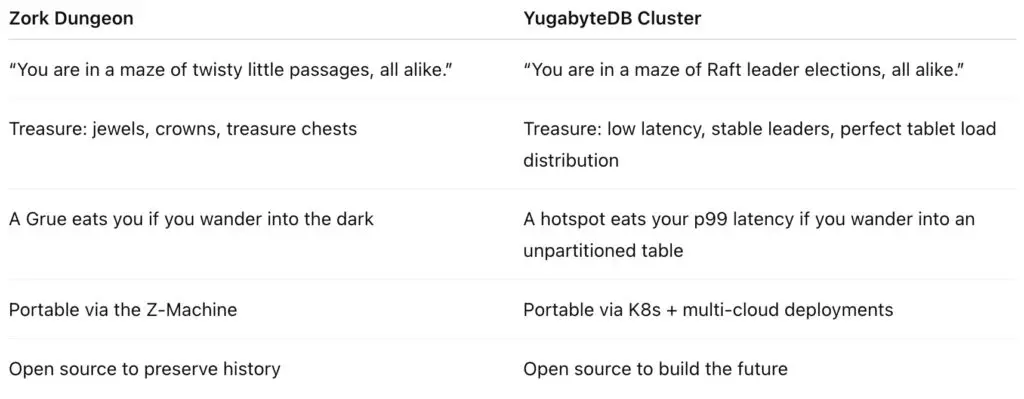
⚔️ Side-by-Side: Zork vs YugabyteDB
🗺️ Cartoon ASCII Map: The Cluster as a Dungeon
Here’s a silly little “map” of a 3-node YugabyteDB universe, drawn like an old text-adventure:
					  .                         [ yb-master-1 ]
                                |
        -------------------------------------------------
        |                       |                       |
        v                       v                       v

   [ tserver-1 ]           [ tserver-2 ]           [ tserver-3 ]
        |                       |                       |
   -----------             -------------           -------------
   | Tablet A |             | Tablet B |           | Tablet C |
   |  (RF=3)  |             |  (RF=3)  |           |  (RF=3)  |
   -----------             -------------           -------------

Legend:
- RF=3            : Each tablet has 3 replicas across tservers.
- yb-master-1     : Knows the map of the dungeon (cluster metadata).
- tserver-*       : Rooms where your data "lives".
- Tablets A/B/C   : Shards of your table, each guarded by Raft.

From the ysqlsh prompt, it might read like this:

You are standing in a distributed cluster.
There are 3 tablet servers here.
A yb-master is humming quietly overhead.

Exits:
  NORTH  -> tserver-1 (leader for Tablet A)
  EAST   -> tserver-2 (follower for Tablet A, leader for Tablet B)
  SOUTH  -> tserver-3 (follower for Tablets A and B, leader for Tablet C)
🧪 SQL Mini-Demo: Welcome to ZorkDB
Let’s make a tiny “Zork-style” demo inside YugabyteDB that feels like a text adventure but is really just good old YSQL.
1. Create the dungeon (rooms)
					-- Our dungeon rooms
CREATE TABLE rooms (
  room_id      BIGINT GENERATED BY DEFAULT AS IDENTITY PRIMARY KEY,
  name         TEXT NOT NULL,
  description  TEXT NOT NULL
) PARTITION BY HASH (room_id);

-- Hash partitions across the cluster (change MODULUS for your size)
CREATE TABLE rooms_p0 PARTITION OF rooms
  FOR VALUES WITH (MODULUS 4, REMAINDER 0);

CREATE TABLE rooms_p1 PARTITION OF rooms
  FOR VALUES WITH (MODULUS 4, REMAINDER 1);

CREATE TABLE rooms_p2 PARTITION OF rooms
  FOR VALUES WITH (MODULUS 4, REMAINDER 2);

CREATE TABLE rooms_p3 PARTITION OF rooms
  FOR VALUES WITH (MODULUS 4, REMAINDER 3);
2. Populate our “world”
					INSERT INTO rooms (name, description) VALUES
('Central Chamber',
 'You are standing in the Central Chamber of the cluster. Tablet leaders whisper around you.'),
('Latency Cavern',
 'You are in a dark cavern. The p99 latency is high here. You sense an unindexed JOIN.'),
('Hotspot Hallway',
 'This hallway glows red-hot. Most of the traffic seems to hit a single partition key.'),
('Metrics Observatory',
 'You are in a quiet observatory. A dashboard glows with PromQL and percentiles.');
💎 3. Add a Treasures Table
Because no Zork-inspired dungeon is complete without loot.
					CREATE TABLE treasures (
  treasure_id  BIGINT GENERATED BY DEFAULT AS IDENTITY PRIMARY KEY,
  room_id      BIGINT NOT NULL REFERENCES rooms(room_id),
  name         TEXT NOT NULL,
  value        INT NOT NULL,
  description  TEXT NOT NULL
) PARTITION BY HASH (treasure_id);

CREATE TABLE treasures_p0 PARTITION OF treasures FOR VALUES WITH (MODULUS 4, REMAINDER 0);
CREATE TABLE treasures_p1 PARTITION OF treasures FOR VALUES WITH (MODULUS 4, REMAINDER 1);
CREATE TABLE treasures_p2 PARTITION OF treasures FOR VALUES WITH (MODULUS 4, REMAINDER 2);
CREATE TABLE treasures_p3 PARTITION OF treasures FOR VALUES WITH (MODULUS 4, REMAINDER 3);
Populate the treasure hoard
					INSERT INTO treasures (room_id, name, value, description)
SELECT room_id, 'Shiny Jewel', 100,
       'A sparkling gemstone that hums with low-latency energy.'
FROM rooms WHERE name = 'Central Chamber';

INSERT INTO treasures (room_id, name, value, description)
SELECT room_id, 'Ancient Query Plan', 250,
       'A dusty scroll describing an execution plan from long ago.'
FROM rooms WHERE name = 'Latency Cavern';

INSERT INTO treasures (room_id, name, value, description)
SELECT room_id, 'Hot Key of Destiny', 500,
       'A glowing key that holds immense power… and attracts *way* too much traffic.'
FROM rooms WHERE name = 'Hotspot Hallway';

INSERT INTO treasures (room_id, name, value, description)
SELECT room_id, 'Crystal of Clarity', 300,
       'A shimmering crystal that reveals p50, p95, and p99 latency at a glance.'
FROM rooms WHERE name = 'Metrics Observatory';
👁️ 4. Add the Zork-style look() function
This function prints the description of a room as if you’re playing a text adventure.
It returns a nicely formatted block that feels very Zork:
					CREATE OR REPLACE FUNCTION look(room_name text)
RETURNS text
LANGUAGE plpgsql
AS $$
DECLARE
    v_desc text;
    v_id   bigint;
    v_treasures text;
BEGIN
    SELECT room_id, description
      INTO v_id, v_desc
      FROM rooms
     WHERE name ILIKE room_name
     LIMIT 1;

    IF NOT FOUND THEN
        RETURN format(
            E'You look around...\n' ||
            E'There is no room called "%s" here.\n' ||
            E'Perhaps you should explore further.',
            room_name);
    END IF;

    -- Find treasures
    SELECT string_agg(format('%s (value: %s)', name, value), E'\n')
      INTO v_treasures
      FROM treasures
     WHERE room_id = v_id;

    IF v_treasures IS NULL THEN
        v_treasures := 'No treasures here.';
    END IF;

    RETURN format(
        E'You are in room #%s: %s\n\n%s\n\nTreasures:\n%s\n',
        v_id, room_name, v_desc, v_treasures);
END;
$$;
Try it out:
					SELECT look('Central Chamber');
SELECT look('Hotspot Hallway');
SELECT look('Metrics Observatory');
Example play through:
					yugabyte=# SELECT look('Central Chamber');
                                            look
--------------------------------------------------------------------------------------------
 You are in room #1: Central Chamber                                                       +
                                                                                           +
 You are standing in the Central Chamber of the cluster. Tablet leaders whisper around you.+
                                                                                           +
 Treasures:                                                                                +
 Shiny Jewel (value: 100)                                                                  +

(1 row)

yugabyte=# SELECT look('Hotspot Hallway');
                                         look
--------------------------------------------------------------------------------------
 You are in room #3: Hotspot Hallway                                                 +
                                                                                     +
 This hallway glows red-hot. Most of the traffic seems to hit a single partition key.+
                                                                                     +
 Treasures:                                                                          +
 Hot Key of Destiny (value: 500)                                                     +

(1 row)

yugabyte=# SELECT look('Metrics Observatory');
                                      look
--------------------------------------------------------------------------------
 You are in room #4: Metrics Observatory                                       +
                                                                               +
 You are in a quiet observatory. A dashboard glows with PromQL and percentiles.+
                                                                               +
 Treasures:                                                                    +
 Crystal of Clarity (value: 300)                                               +

(1 row)
Or when something doesn’t exist:
					yugabyte=# -- A room that doesn't exist:
yugabyte=# SELECT look('Grue Nest');
                   look
-------------------------------------------
 You look around...                       +
 There is no room called "Grue Nest" here.+
 Perhaps you should explore further.
(1 row)
This is way too fun for anyone who’s spent hours spelunking through latency graphs and Raft logs.
🔧 Why This Matters
Both Zork and YugabyteDB share something powerful… something that only open source makes possible:
● Open source turns software into knowledge.
○ Not just a product you run, but a resource you can read, study, dissect, and learn from.
● Openness invites exploration.
○ You’re free to dive into the internals, understand design choices, trace logic, and improve the system itself.
● Open source preserves history and enables progress.
○ Zork’s code release protects a foundational artifact of early computing.
○ YugabyteDB’s openness ensures future engineers can build upon a globally distributed SQL engine without its knowledge locked away.
● Transparency builds trust.
○ When you can see every line, every algorithm, and every architectural decision, debugging gets easier, security gets stronger, and innovation accelerates.
Communities grow around open code.
○ Zork sparked decades of creativity, mods, rewrites, and homages.
○ YugabyteDB’s community drives features, fixes, docs, integrations, and real-world deployments.
Open systems endure — closed systems disappear.
○ Closed software fades when companies fold, teams reorganize, or formats die.
○ Open software lives on through forks, mirrors, archives, and contributions.
With Zork, you explore a fantasy labyrinth.
With YugabyteDB, you explore the blueprint of a global-scale distributed SQL engine.
In both worlds, curiosity isn’t just encouraged… it’s the key that unlocks everything!
📚 Fun Fact: Where the Name Zork Came From
Zork started as an MIT hacker joke… a nonsense word programmers used to label unfinished, experimental, or placeholder programs (“Let’s zork around with this…”). When the opriginal Dungeon game needed a working title, the developers slapped Zork on it temporarily… and the name stuck forever!
📝 Tip Summary
● Zork I/II/III going open source is a fun reminder of how open code fuels creativity.
● YugabyteDB is similarly open… but for cloud-native, mission-critical, real-world adventures.
● A distributed SQL cluster feels like a dungeon sometimes, so we gave it a map and a little SQL mini-game.
● Hotspots are the Grues of distributed systems: stay in the light (good schema, good partitioning, good indexes). 👹
Have Fun!