
Yugabyte has a new offering: YugabyteDB AMP, short for Agentic Multitenant Postgres.
AI agents create a different kind of database workload. Many start small, run only occasionally, and spend much of their time idle. But if an agent becomes successful, its database may suddenly need more throughput, stronger isolation, higher availability, or even geo-distributed scale.
YugabyteDB AMP is designed for that entire lifecycle.
You can start with serverless, scale-to-zero PostgreSQL, give each agent its own isolated database, and then grow successful workloads into fully distributed YugabyteDB without migrating to a different database platform or rewriting the application.
Why Give Every Agent Its Own Database?
One of the core AMP ideas is simple:
- Give each agent its own real PostgreSQL database.
Instead of placing hundreds of agents into one shared schema or depending entirely on row-level filtering for tenant separation, AMP can provision an independent PostgreSQL database for each workload.
Serverless Multitenancy then packs hundreds of those small databases onto shared distributed infrastructure. The agents share the underlying infrastructure, but each gets its own database boundary.
That means an agent can have its own schema, tables, extensions, credentials, application state, vector data, and lifecycle without requiring a dedicated database server for every workload.
Scale to Zero Fits Agent Workloads
Traditional database infrastructure generally assumes that applications are continuously active.
Agents often aren’t.
An agent may wake up, perform a burst of work, and then sit idle for hours. Another may exist only for a short experiment. A development team may create dozens or hundreds of agents whose usage is unpredictable.
AMP uses a true scale-to-zero serverless model. You pay by CPU minute, and idle agents incur no CPU charge. There are also no pass-through fees in the current AMP pricing model.
Start Serverless. Grow Distributed.
This is probably the part of AMP that I find most interesting architecturally.
The traditional path for a new AI application can look something like this:
AMP is designed to avoid that migration step.
A workload can begin on the serverless AMP tier and, when it needs sustained throughput, geo-distribution, or greater resilience, transition to fully distributed YugabyteDB. The data stays on YugabyteDB, and the application continues using PostgreSQL. Yugabyte calls this the AMP-to-Distributed Seamless Path.
Serverless PostgreSQL
Distributed YugabyteDB
More Than Serverless PostgreSQL
AMP combines the serverless database with the capabilities needed to operate an entire fleet of agent databases.
| Capability | What You Can Do |
| Serverless Multitenancy | Run hundreds of small, bursty agent databases on shared distributed infrastructure. |
| Database-Level Isolation | Give each agent its own real PostgreSQL database rather than a shared schema or row filter. |
| Resource Governance | Control CPU consumption so one workload cannot monopolize the shared infrastructure. |
| Fleet Management | Batch-create databases, apply quotas, and manage hundreds of agent workloads as one fleet. |
| Connection Manager | Multiplex thousands of client connections onto a much smaller backend connection pool. |
| Agent-Operable Lifecycle | Provision, migrate, tune, integrate, branch, scale, and tear down database environments through agent-driven workflows. |
| AMP-to-Distributed Path | Grow a successful workload into fully distributed YugabyteDB without re-platforming the database. |
Keep One Agent From Becoming a Noisy Neighbor
Consolidating hundreds of databases onto shared infrastructure creates an obvious question:
- What stops one busy agent from consuming the CPU needed by everybody else?
YugabyteDB Resource Governance handles CPU sharing across databases. During contention, CPU is allocated fairly so one database cannot monopolize the cluster. You can also apply an optional CPU cap to limit how much a database is allowed to consume. When spare CPU exists, workloads can still make use of the available capacity.
AMP supports CPU controls today. RAM, storage, and network controls are planned additions.
Let Agents Operate the Database Too
The AMP agent story goes beyond:
AMP includes four specialized agents that handle parts of the database lifecycle.
| Built-In Agent | What It Does |
| YugabyteDB Architect | Composes and provisions the database setup. |
| YugabyteDB Voyager | Drives database migrations. |
| YugabyteDB Perf Advisor | Troubleshoots and tunes database performance. |
| YugabyteDB Nexus | Manages external integrations such as connectors, event streams, and BI tools. |
AMP also supports instant copy-on-write branching for safe testing, and database lifecycle actions can be logged through Meko decision traces.
Agents Can Use MCP to Reach the Database
YugabyteDB MCP Server gives agents a structured interface for working with YugabyteDB.
MCP supports OIDC authentication for shared or remote deployments, allowing an authenticated caller to execute SQL using the appropriate YugabyteDB database role. AMP’s MCP integration keeps write-capable tools disabled until an operator explicitly enables them.
Built-In Connection Management
Large numbers of agents can also mean large numbers of database connections.
AMP includes YugabyteDB Connection Manager, a server-side connection pooler that can multiplex thousands of client connections onto a smaller number of backend database connections.
You do not need to deploy a separate PgBouncer layer simply to handle that connection fan-out.
It Is Still PostgreSQL
You connect to AMP using the PostgreSQL ecosystem you already know.
Existing PostgreSQL drivers, ORMs, SQL, and extensions continue to be the application interface. When a workload grows into distributed YugabyteDB, the database platform scales underneath it instead of forcing the application onto a completely different API
More Than Relational Data
Agent applications often need more than tables and indexes.
AMP databases support PostgreSQL alongside vector search and graph queries, while the broader YugabyteDB 2026.1 platform includes vector search, in-database RAG, and graph capabilities. This lets applications keep AI-oriented data close to the operational data it belongs to rather than automatically requiring a separate database for every data model.
There is plenty to unpack here, so vector search, RAG, graph, and GraphRAG deserve separate YugabyteDB Tips rather than trying to cover all of them in this introduction.
Where Can AMP Run?
You can deploy YugabyteDB AMP as a fully managed service, or you can self-manage it in your own VPC or on-premises Kubernetes environment.
Self-managed deployments use the same cloud control plane without requiring inbound ports into your infrastructure.
What AMP Is… and What It Isn’t
Final Takeaway
YugabyteDB has traditionally solved the problem at the other end of the database lifecycle: applications that already need distributed scale, resilience, and geographic availability.
AMP changes where that YugabyteDB journey can begin.
An agent can start with a small serverless PostgreSQL database, consume virtually no compute while idle, share infrastructure with hundreds of other isolated databases, and then grow toward fully distributed YugabyteDB when the workload becomes important enough to require it.
Resources
| Resource | Description |
| YugabyteDB AMP | Official YugabyteDB AMP product page and overview of serverless multitenancy, fleet management, agent-operated lifecycle, and the AMP-to-Distributed path. |
| A PostgreSQL Database for Every Agent | Launch article introducing YugabyteDB AMP and the broader YugabyteDB 2026.1 agentic data platform. |
| YugabyteDB: The Data Backbone for Thousands of Agents | Deeper look at starting on AMP and growing workloads into distributed YugabyteDB without migration or rewrite. |
| Introducing YugabyteDB Resource Governance | Detailed explanation of fair CPU sharing, workload isolation, CPU caps, and noisy-neighbor protection. |
| YugabyteDB MCP Server | Documentation for connecting AI agents to YugabyteDB through MCP, including OIDC authentication. |
| What’s New in YugabyteDB 2026.1 | Release information for the YugabyteDB 2026.1 series, including Resource Governance and other platform capabilities. |
| YugabyteDB AMP for the Agentic Era | On-demand webinar covering AMP architecture, scaling, isolation, and the four specialized database agents. |
Have Fun!
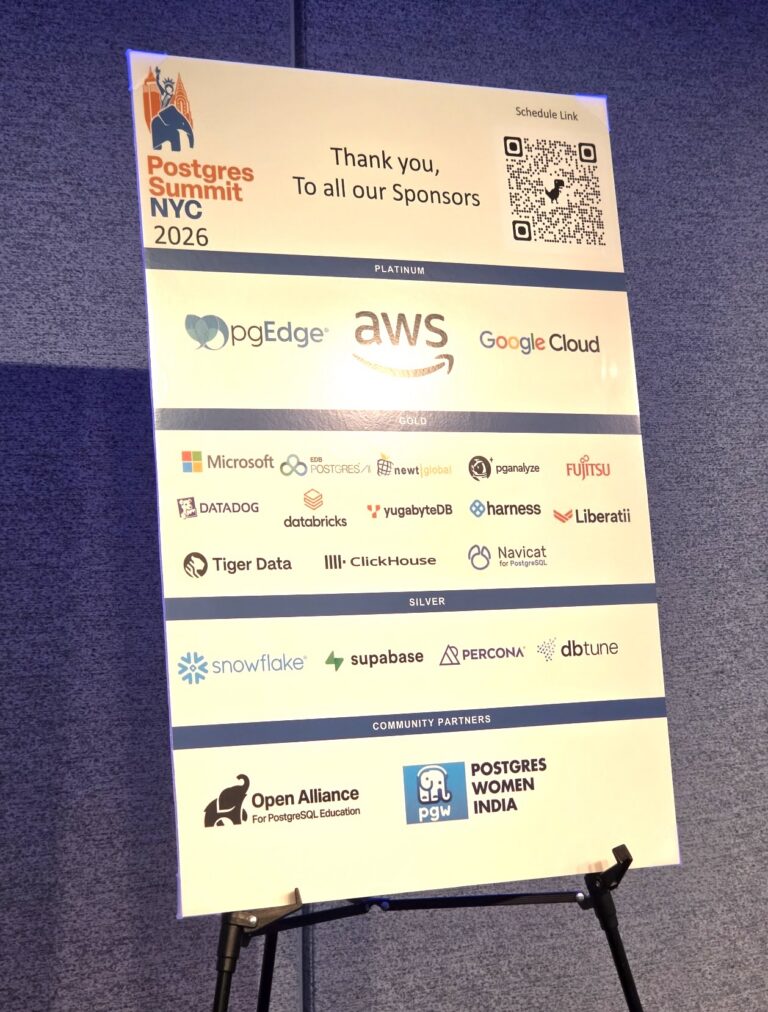
YugabyteDB is proud to be a Gold Sponsor of Postgres Summit US 2026 in NYC! 🐘🚀
If you’re attending the conference, be sure to stop by the YugabyteDB display to meet the team, check out some demos, and chat with us about distributed PostgreSQL, scalability, resilience, and everything Postgres.
Great to be here supporting the PostgreSQL community alongside so many fantastic sponsors!
And a special thanks to Heather Hames, Field Marketing Manager, Events at YugabyteDB, for all the work organizing and coordinating our presence at the event! 🙌