Meet Meko: Shared Context for AI Agents That Work and Learn Together

AI agents are good at reasoning.

They are not always good at remembering what already happened somewhere else.

You may spend an hour teaching one coding agent about a project, switch to another tool the next day, and discover that you’re explaining the same architecture, decisions, and preferences all over again.

The problem gets even bigger with multi-agent systems. Agent A discovers something useful, but Agent B starts from scratch because that learning never became shared context.

Meko is designed to solve that problem.

Meko is an agent-native context layer for persistent memory, shared knowledge, conversations, and decision traces. It lives independently of any one AI model or client and connects to agents through MCP.

🆕 Meet Meko

Meko gives AI agents a shared context layer for persistent memory, shared knowledge,
conversations, and decision traces
.
Instead of trapping context inside one chat client, coding assistant, or model,
Meko lets that context persist across agents, tools, sessions, and time.
And yes… Meko is built on YugabyteDB.

The Problem: Every Agent Starts Over

Without a shared context layer, an agent’s useful discoveries can remain isolated inside one conversation or tool.

The result can look something like this:

Agent A Learns Something
↓
Context Stays in Agent A
↓
Agent B Starts Cold
↓
Rediscover the Same Context

Meko changes that model.

Your agents connect to the same context layer, allowing knowledge and selected learnings to survive tool changes and agent handoffs. Meko is private by default, and you decide what gets shared.

Agent A Learns
↓
Meko
↓
Agent B Can Reuse It

The Core Building Block: A Datapack

The fundamental unit in Meko is called a datapack.

Think of a datapack as the shared context container for an application, project, or group of agents working together.

A datapack combines the information agents need to remember and share with the infrastructure required to retrieve it. Meko documentation recommends roughly one datapack per application or project, and treats the datapack as the isolation boundary for cooperating agents.

At the conceptual level, a datapack contains four important things:

Datapack Component What It Stores
Conversations The full interaction history between humans and agents.
Memory Durable facts, preferences, decisions, and learnings extracted from conversations.
Shared Knowledge Documents and reviewed information that agents with access to the datapack can search and reuse.
Decision Traces The record of how an interaction unfolded, including retrievals, memory operations, tool use, and execution details.

A simple way to visualize it:

Meko Datapack
↓
Conversations
+
Memories
+
Shared Knowledge
+
Decision Traces

Memory That Survives the Session

A normal chat session has an obvious limitation: eventually the session ends.

Meko stores durable memories outside the model session so they can be retrieved later. These memories can include facts, preferences, decisions, and other useful information extracted from conversations. Retrieval combines semantic, keyword, and entity-aware techniques.

That gives you a different workflow:

Conversation Today
↓
Durable Memory Saved in Meko
↓
Retrieve It Tomorrow
↓
Continue Instead of Restart

Private Memory vs. Shared Knowledge

This distinction is important.

Not everything one agent remembers should automatically become shared knowledge.

Meko keeps memories scoped appropriately and allows reviewed memories to be promoted into the shared knowledge layer. That lets you preserve private or agent-specific context while deliberately sharing the information that should become common knowledge.

Agent Memory
↓
Review / Decide What to Share
↓
Shared Datapack Knowledge
↓
Other Agents Can Reuse It
💡 Collective Memory Does Not Mean Share Everything
Meko separates agent-specific memory from shared knowledge.
That gives you control over which learnings remain scoped to an agent and which become reusable knowledge for the wider team.

Build a Knowledge Base Without Building the Pipeline

You can also upload documents directly into a datapack knowledge base.

Meko handles document chunking, embedding, indexing, and retrieval so agents can search that material without you first building a separate preprocessing and RAG pipeline.

That means things like:

  • ● architecture documents
  • ● Markdown
  • ● PDFs
  • ● standards and procedures
  • ● product documentation
  • ● project notes

can become searchable context for every authorized agent using the datapack.

Switch Tools Without Losing the Project

Meko sits outside any one AI vendor.

That means your project context is not tied exclusively to one model, coding assistant, or chat application. Both Meko’s site and current documentation list integrations with tools such as ChatGPT, Claude, Codex, Cursor, VS Code, Claude Code, and other MCP-capable clients.

Conceptually:

ChatGPT
+
Claude
+
Cursor / Codex / VS Code / Other MCP Clients
↓
One Meko Context Layer

One MCP Endpoint

Meko exposes its context layer through a hosted MCP server.

Your AI client connects to Meko, authenticates, and then uses MCP tools to search knowledge, recall memory, persist conversations, and interact with datapacks.

All datapacks use the same hosted MCP endpoint; the datapack ID or name supplied in the MCP call determines which datapack is being accessed.

AI Agent or Client
↓
Model Context Protocol (MCP)
↓
Meko Datapack

Decision Traces: See What Happened

Persistent context becomes much more useful when you can also understand how it got there.

Meko records decision traces that connect conversations to memory and knowledge operations, searches, tool calls, API and SQL activity, and retrieved results.

That gives developers and operators a way to inspect:

  • ● what information an agent searched
  • ● what memory it retrieved
  • ● what knowledge it used
  • ● what tools were invoked
  • ● what was written back
  • ● how much work or token usage was associated with an interaction

That becomes especially important when multiple agents are continuously learning from one another.

🔍 Memory Without Auditability Is Only Half the Story
Meko does not just store what an agent remembers.
Decision traces help you inspect how context was retrieved, applied, changed, and shared across the system.

Recall Instead of Regenerate

There is also an economic benefit to shared context.

If another agent has already researched a problem, parsed a document, or reached a useful conclusion, the next agent can retrieve that result instead of feeding the same source material back through an LLM and paying to reason through it again.

Meko explicitly encourages agents to recall previously computed context instead of regenerating it.

The idea is straightforward:

Reprocess Everything Again
vs.
Retrieve What Was Already Learned

You Don’t Have to Build a Patchwork Data Stack

Agent context often ends up spread across multiple specialized systems:

  • ● Relational database
  • ● Vector database
  • ● Graph database
  • ● Object storage
  • ● RAG pipeline
  • ● Conversation store
  • ● Tracing system

Meko hides much of that complexity behind agent-native constructs such as memory, knowledge, conversations, and traces. Its unified data layer combines vector, SQL, graph, search, and other storage/retrieval capabilities behind a PostgreSQL-compatible platform.

❌ Build It Yourself
Vector store
Graph store
Relational database
RAG pipeline
Object storage
Custom memory logic
Custom audit/tracing
✅ Meko
Memory
Knowledge
Conversations
Decision traces
One MCP interface
One managed context layer

Built on YugabyteDB

This is where Meko becomes especially relevant to readers of yugabytedb.tips.

Meko’s persistent data layer is built on YugabyteDB. Meko uses a unified distributed PostgreSQL-compatible platform for relational, vector, graph, document, and search-oriented workloads instead of requiring agents to assemble those capabilities from independent databases.

🐘 Meko Is Powered by YugabyteDB
Meko presents agent-native concepts such as memory, knowledge, conversations, and traces.
Underneath that abstraction is YugabyteDB’s distributed PostgreSQL-compatible data platform, giving Meko a unified foundation for multiple data and retrieval models.

Meko and AMP Solve Different Problems

This is worth calling out, especially if you’ve already read the introductory YugabyteDB AMP Tip, Meet YugabyteDB AMP: A PostgreSQL Database for Every Agent.

AMP gives agents databases.

Meko gives agents shared context.

Yugabyte describes AMP as the database platform for fleets of agents, while Meko provides persistent memory, shared knowledge, conversation history, and decision traces that agents access through MCP.

Offering Think of It As…
YugabyteDB AMP A PostgreSQL database platform for agent workloads and agent fleets.
Meko A shared context layer for memory, knowledge, conversations, and decision traces.

They complement each other rather than replace each other.

Try Meko for Free

You can create a Meko account yourself today.

The current Free plan requires no credit card and no waitlist and includes up to 10 datapacks, 1,000 conversations per month, 10,000 retrievals per month, 10 million Workbench tokens, and 100 MB of knowledge storage. The Pro plan adds team sharing, role-based access, larger/custom limits, SSO, and additional organizational capabilities.

The easiest way to explore Meko is WorkbenchLM, the chat experience built into the portal. It lets you watch memory and decision traces update without installing another AI client.

Create a Free Meko Account
↓
Create or Open a Datapack
↓
Add Knowledge
↓
Connect an MCP Client
↓
Start Building Shared Context

What Meko Is… and What It Isn’t

✅ What Meko Is
A persistent context layer for agents and humans.
Shared memory, searchable knowledge, conversations, and decision traces.
Independent of any one AI model or client.
Accessible through MCP.
❌ What Meko Isn’t
An AI model.
An AI agent by itself.
Memory tied to one chat application or vendor.
Just another standalone vector database.

Meko itself is explicitly not an AI agent; it is the data/context layer that agents connect to.

Final Takeaway

AI agents become much more useful when their context survives the individual session.

Meko gives agents somewhere durable to keep what they learned, somewhere common to retrieve shared knowledge, and a traceable record of how that context was created and used.

Instead of this:
Agent Learns Something
↓
Session Ends
↓
Context Disappears
↓
Next Agent Starts Again
You get this:
Agent Learns
↓
Meko Persists the Context
↓
Useful Learning Can Be Shared
↓
The Next Agent Builds on It
💡 The Big Idea
Your agents shouldn’t have to rediscover what your other agents already learned.
Meko gives agents a persistent, shared context layer that survives sessions, models, tools, and handoffs.
And because that layer is built on YugabyteDB, it has a distributed PostgreSQL-compatible data platform underneath it as the agent system grows.

Resources

Resource Description
Meko Official Meko site and overview of collective memory, shared knowledge, decision traces, integrations, and use cases.
Meko Documentation Technical documentation covering datapacks, memory, knowledge, traces, MCP integrations, and architecture.
Meko Quick Start Start with WorkbenchLM, connect your AI client, or integrate Meko into your own agent application.
Meko Datapacks Learn how datapacks provide the isolation boundary for memory, knowledge, conversations, and traces.
Meko Knowledge Bases See how Meko parses, chunks, embeds, indexes, and searches documents without requiring a separate vector database.
Meko Learnings Learn how private agent memory can be reviewed and promoted into shared institutional knowledge.
Meko Decision Traces Explore end-to-end observability into memory operations, retrievals, MCP calls, SQL execution, latency, and token usage.
Meko Pricing Current Free and paid plan limits for datapacks, conversations, retrievals, knowledge storage, and team features.
Discover Meko Yugabyte’s introduction to Meko and the shared-memory, shared-knowledge, and decision-trace problems it is designed to solve.
Shared Memory for AI Coding Agents On-demand hands-on session showing two agents sharing context through Meko.

Have Fun!

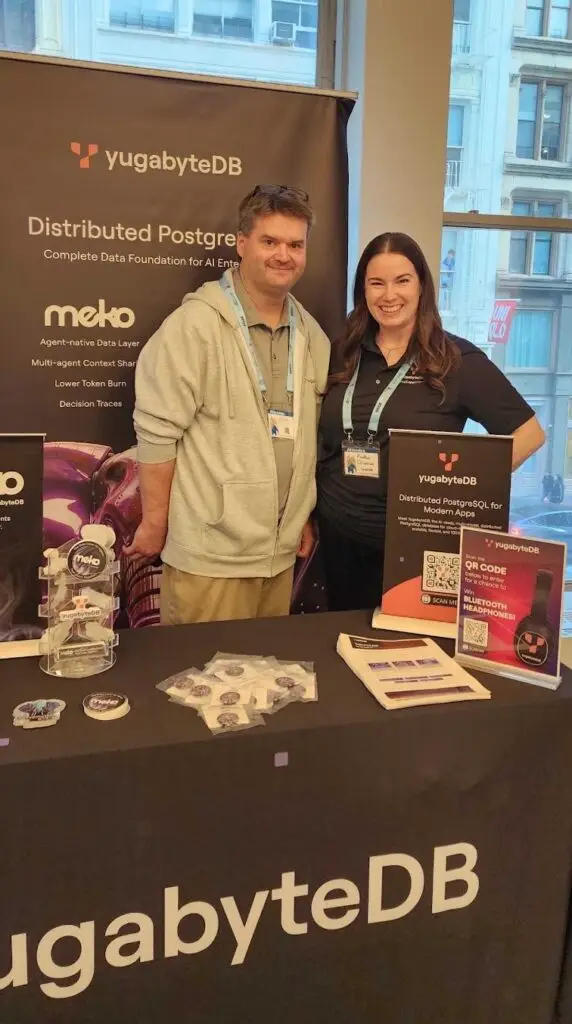
This is a picture of me and Heather Downing, Developer Advocate at YugabyteDB, at our display at Postgres Summit US 2026 in NYC, running Sept. 30–Oct. 2! 🚀

Stop by and meet the team, check out some live demos, and talk with us about how distributed PostgreSQL can deliver horizontal scalability, global availability, and ultra-resilience… without giving up PostgreSQL compatibility.

And if you’re here today, be sure to catch Heather’s session:

🧠 Agent Memory Is Three Postgres Extensions in a Trench Coat
📅 Today, October 1 | 11:30 AM–12:20 PM

Heather will show how PostgreSQL itself can serve as the memory layer for AI agents by combining three different ways of representing and retrieving knowledge: raw text with full-text search, embeddings with pgvector, and entity relationships stored as a graph with Apache AGE. She’ll build an agent memory live and demonstrate how hybrid retrieval across all three approaches can help agents resume previous work, share learned knowledge, and even answer the question, “Why does the agent believe this?” with SQL. 🐘🤖

If you’re at the Summit, come say hello… and definitely check out Heather’s talk!